Introduction
As AI agent systems evolve, the transition from single-agent to multi-agent systems is accelerating. This article explores how to design a platform architecture for efficient communication between multiple agents.
1. Architecture Overview
A multi-agent platform consists primarily of an Orchestrator, Message Bus, and various specialized agents.

Core Components
| Component | Role |
|---|---|
| Orchestrator | Task coordination, agent scheduling |
| Message Bus | Inter-agent communication relay |
| State Store | Shared state management |
| Task Queue | Priority-based work queue |
| Agents | Specialized task execution |
2. Communication Protocol Design
Inter-agent communication is designed based on asynchronous message passing.
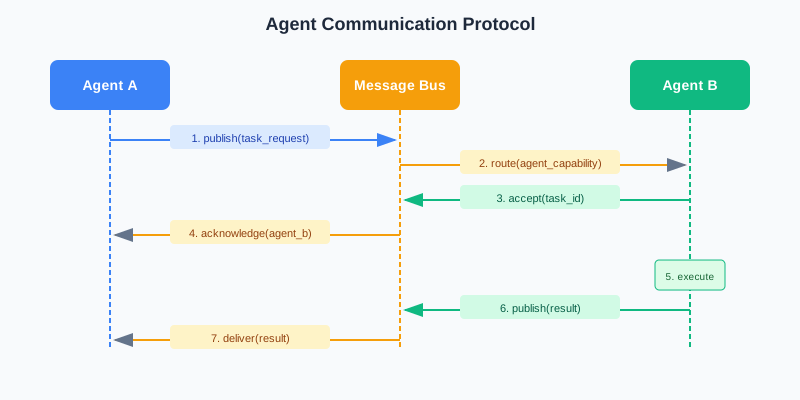
Communication Flow
- Publish: Agent publishes task request to message bus
- Route: Bus routes message to appropriate agent
- Accept: Target agent accepts task
- Acknowledge: Bus sends acceptance confirmation to requester
- Execute: Agent performs actual work
- Result: Result is published to bus
- Deliver: Bus delivers result to requester
3. Message Structure
Design scalable and type-safe message structures.
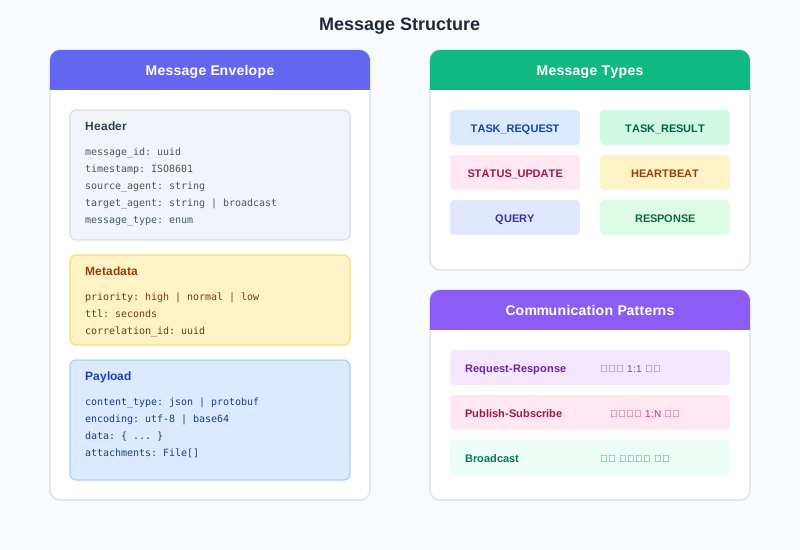
Message Envelope
{
  "header": {
    "message_id": "uuid-v4",
    "timestamp": "2026-02-21T12:00:00Z",
    "source_agent": "agent-research-01",
    "target_agent": "agent-writer-01",
    "message_type": "TASK_REQUEST"
  },
  "metadata": {
    "priority": "normal",
    "ttl": 3600,
    "correlation_id": "parent-uuid"
  },
  "payload": {
    "content_type": "json",
    "encoding": "utf-8",
    "data": {
      "task": "summarize",
      "content": "..."
    }
  }
}
Message Types
| Type | Purpose |
|---|---|
TASK_REQUEST | Task request |
TASK_RESULT | Task result |
STATUS_UPDATE | Status change notification |
HEARTBEAT | Liveness check |
QUERY | Information lookup |
RESPONSE | Query response |
4. Agent State Management
Each agent has a clear state machine.
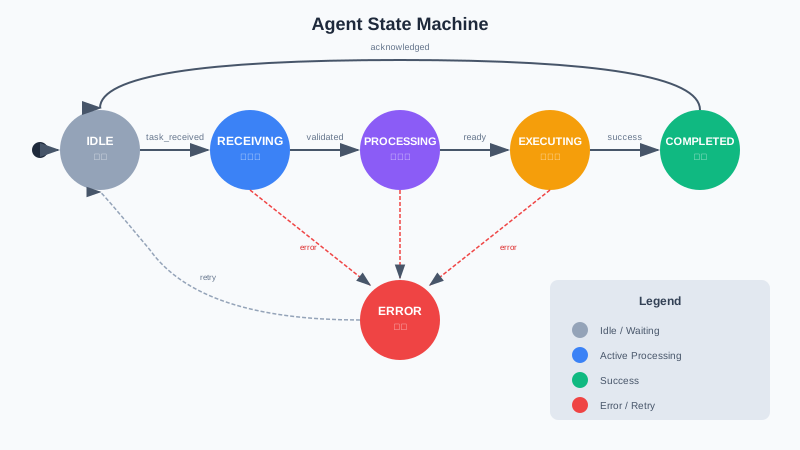
State Transitions
IDLE → RECEIVING → PROCESSING → EXECUTING → COMPLETED → IDLE
                ↘           ↘           ↘
                  ERROR ──────→ retry ──→ IDLE
State Behaviors
| State | Behavior |
|---|---|
| IDLE | Waiting for new task |
| RECEIVING | Message reception and validation |
| PROCESSING | Task analysis and preparation |
| EXECUTING | Actual work execution |
| COMPLETED | Result transmission and cleanup |
| ERROR | Error handling and retry |
5. Communication Patterns
5.1 Request-Response
Synchronous 1:1 communication pattern.
# Request
response = await bus.request(
    target="agent-code-01",
    message=TaskRequest(task="generate_code", spec={...}),
    timeout=30
)

# Response
return TaskResult(status="success", data=generated_code)
5.2 Publish-Subscribe
Asynchronous 1:N communication pattern.
# Subscribe
@bus.subscribe("research.completed")
async def handle_research_result(message):
    # Handle research result
    pass

# Publish
await bus.publish(
    topic="research.completed",
    message=ResearchResult(data={...})
)
5.3 Broadcast
Used to send notifications to all agents.
# Broadcast
await bus.broadcast(
    message=SystemAlert(
        level="warning",
        message="High load detected"
    )
)
6. Core Design Principles
6.1 Loose Coupling
Agents should not know each other’s internal implementations. They communicate only through message interfaces.
6.2 Fault Tolerance
class Agent:
    async def execute_with_retry(self, task, max_retries=3):
        for attempt in range(max_retries):
            try:
                return await self.execute(task)
            except Exception as e:
                if attempt == max_retries - 1:
                    await self.transition_to(State.ERROR)
                    raise
                await asyncio.sleep(2 ** attempt)  # Exponential backoff
6.3 Scalability
- Horizontal scaling: Add agents with the same role
- Load balancing: Automatic distribution by message bus
- Sharding: Separate agent groups by task type
6.4 Observability
# Metrics collection
@metrics.track
async def process_message(self, message):
    with metrics.timer("process_duration"):
        result = await self.handle(message)
    metrics.increment("messages_processed")
    return result
7. Implementation Considerations
7.1 Message Serialization
| Format | Pros | Cons |
|---|---|---|
| JSON | Readability, compatibility | Size, performance |
| Protocol Buffers | Performance, schema | Complexity |
| MessagePack | JSON compatible, size | Tool support |
7.2 Backpressure
class Agent:
    def __init__(self, max_concurrent=10):
        self.semaphore = asyncio.Semaphore(max_concurrent)

    async def process(self, message):
        async with self.semaphore:
            return await self.handle(message)
7.3 Dead Letter Queue
Failed messages are moved to a separate queue for analysis and reprocessing.
8. Conclusion
Key elements of a multi-agent communication platform include:
- Flexible message structure: Support for various communication scenarios
- Clear state management: Predictable agent behavior
- Diverse communication patterns: Request-response, publish-subscribe, broadcast
- Fault-tolerant design: Retry, timeout, error handling
Based on these principles, scalable and reliable multi-agent systems can be built.
References
Korean Version: 한국어 버전